
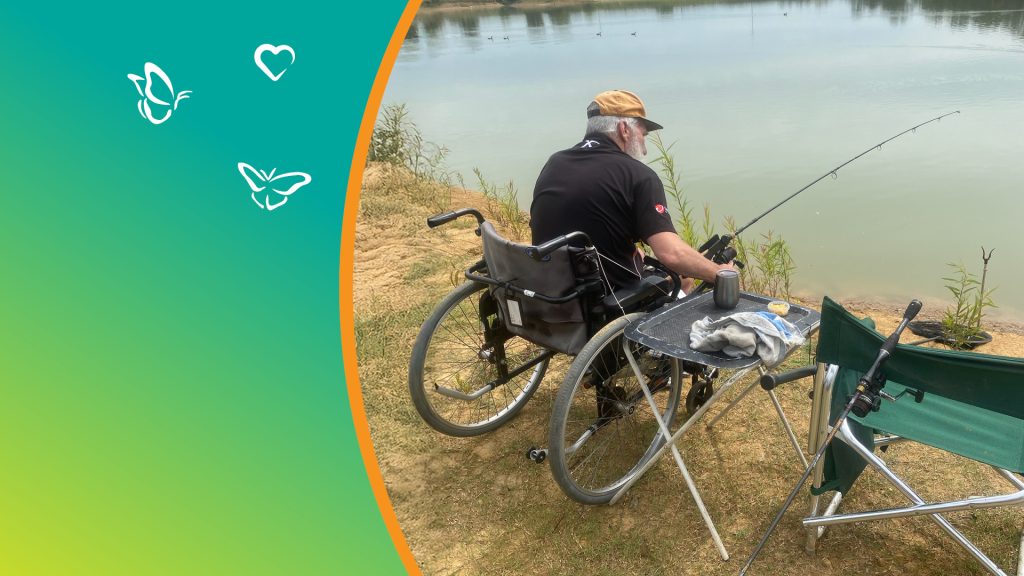
In his younger years, there was nothing Bill liked more than going out on the ocean with friends on a rented boat to fish. “Just the pleasure and serenity … looking at the water,” Bill told us, thinking back to those days. However, 20 years ago, Bill experienced a devastating stroke that left him with only one “Good” arm and leg, requiring him to use a wheelchair for mobility. Since then, he hasn’t been able to enjoy the pleasures of fishing.
But thanks to the efforts of Mark, one of his support workers, Bill has been able to get back out on the water and fish again, returning to something he once loved.
Mark has been working with Bill for some time, often taking him on day trips to help get him out of the nursing home where he lives. One of these frequent trips is to Mark’s property, which has a large lake with a jetty where you can sit right on the water.
Mark’s Lake is stocked with fish, and he often lets other NDIS participants fish there; he also runs a school holiday program that teaches kids how to fish. It was on one of these frequent trips that, knowing Bill’s love for fishing, Mark had the thought, “Gee, it’d be nice if you could have a fishing rod.”
This thought stuck with Mark, and as he mulled it over, a design began to take shape. Being somewhat of a tinkerer, Mark set to work on creating a 3D-printed device to hold a fishing rod. From what Mark describes, it is a multidirectional arm that can swivel left, right, up, and down, and has a tube that a fishing rod can slide into. There are also a few straps that help hold the rod in place, and the entire gadget clamps to the side of Bill’s wheelchair.
Since Bill only has one arm that can operate a fishing rod, he can cast the line and place the rod in the holder, freeing his good arm to tighten the line and wait for the fish to strike. Once the fish is on the line, Bill can reel it in, but he still needs a bit of help to net and land it, something Mark is all too happy to step in and do.
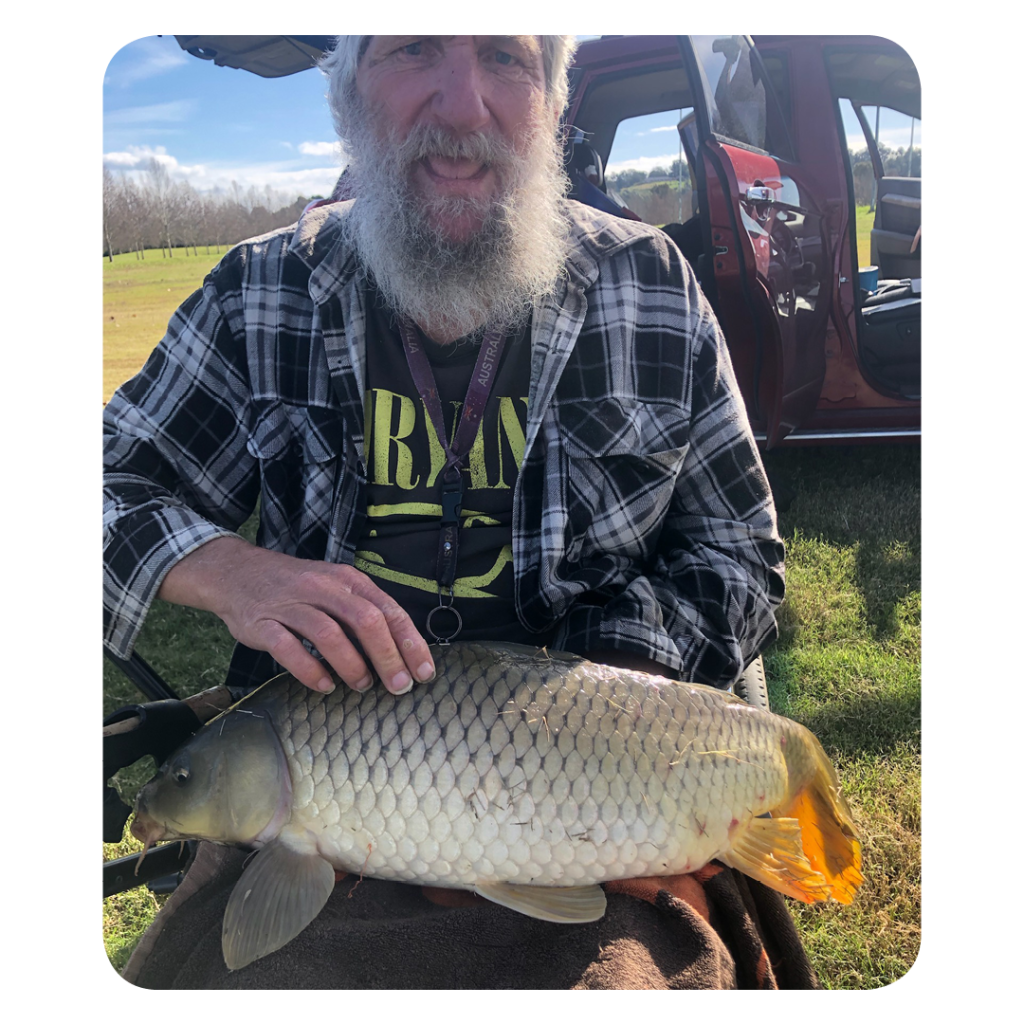
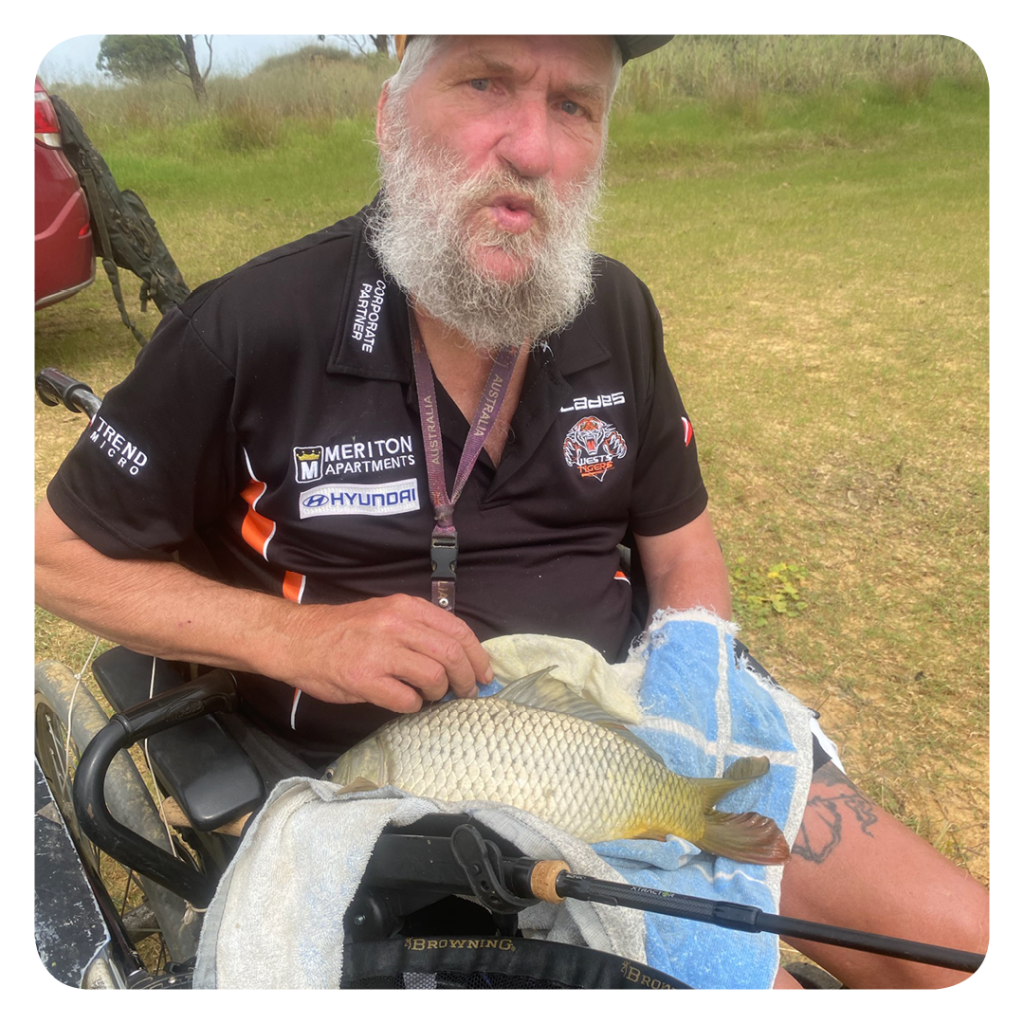
What was it like when he caught his first fish? “I don’t think he stopped talking about it for about a week … He must have told everyone in the nursing home,” Mark told us. Bill’s first successful catch was an amazing experience; he had managed to reel in a 10-pound carp. A feat that most didn’t believe, luckily, Bill had some photos to show off his whopper of a catch.
Bill is still buzzing with the memory, “Pretty good, mate, eh?”
Allowing Bill to fish again isn’t just about finding something for him to do or checking off a task list; it is about giving him the tools he needs to access that part of his identity again. “If you just do the normal stuff, rock up, do the basic stuff, it doesn’t really enhance their life very much,” Mark explains. For Mark, doing just what is required of him for his work is only a starting point; doing small things that let participants enjoy their lives is worth the effort.
There are plenty of well-documented studies that show that community participation for people living with disability is nothing but beneficial. Being part of their community helps build their independence, improves their wellbeing and confidence, and allows them to create genuine social connections with others. It goes to show that NDIS funding for social outings is an invaluable resource for participants’ long-term wellbeing and is core to capacity-building support.
Mark’s support for Bill doesn’t start and end with fishing; they make day trips to the Zoo, have visited Australia’s oldest pub, and explored a property on the Patterson River after a chance meeting with a former Manly footballer.
Their genuine care and respect for one another is also shown in the way they talk about each other.
“Imagine if you’ve been in a nursing home for 20 years and someone comes and says, ‘We’re going fishing today,'” Mark says. “It just makes such a difference.”
“He’s unreal,” Bill says simply. “He’s a top bloke.”
Mark’s 3D-printed gadget isn’t just a clever idea; it is the result of what real support looks like. Mark didn’t just identify Bill’s needs; he saw something that could really affect Bill’s life in a positive way.
“You know, most of the people I look after, I go above and beyond,” Mark says. “Just try and give them some more experiences.”
The extra effort of taking a bit of time to think, create, and problem-solve can make a real difference in a participant’s life, allowing them to achieve their goals and set new ones. Once their horizon expands, suddenly things that might seem like they were out of reach become not only obtainable but doable.
Bill sums up his gratitude with a good bit of humour: “I introduce him to people as me dad, and he introduces me as his daughter.”
For Mark, the cost of making Bill’s rod holder was almost nothing, but that’s only because he already owned the tools and knowledge to complete the project. Not every support worker can have access to these resources, nor is 3D printing the solution to every problem. But Mark’s approach of identifying a participant’s desires and considering steps to realise them is what’s important.
You could have a participant who wants to become a creative writer; finding a writing group they can join can be helpful. Or maybe they want to get into doing something with their hands; looking for community-run work sheds is an option. Whatever your participant wants to achieve, there are always small things you can do to help them along the way.
“The little things that people take for granted,” Mark reflects. “When you spend all day not doing them, you really miss them. It makes a world of difference when you can do them again.”

We acknowledge the connections of First Nations People of Australia to the land, sea and community on which we live and work. As custodians of this sacred land we respect and acknowledge Elders, past, present and emerging.